

Deciding to get divorced is a big decision. And for many people in Orange County, the next thought is almost immediately about money.

“How much is this going to cost me?” “Do I really need to hire an attorney?” “Can I just file for divorce myself?”

The answer to that last question is yes. California allows you to represent yourself, and many people choose a DIY divorce in Orange County to save money and keep control of their case.

But there’s something important I want you to understand: doing your own divorce doesn’t mean you have to do every piece of paperwork on your own.

Your Options for a DIY Divorce in Orange County

Your choices aren’t limited to “hire an attorney for everything” or “do it all yourself.” Here’s how the most common paths compare:
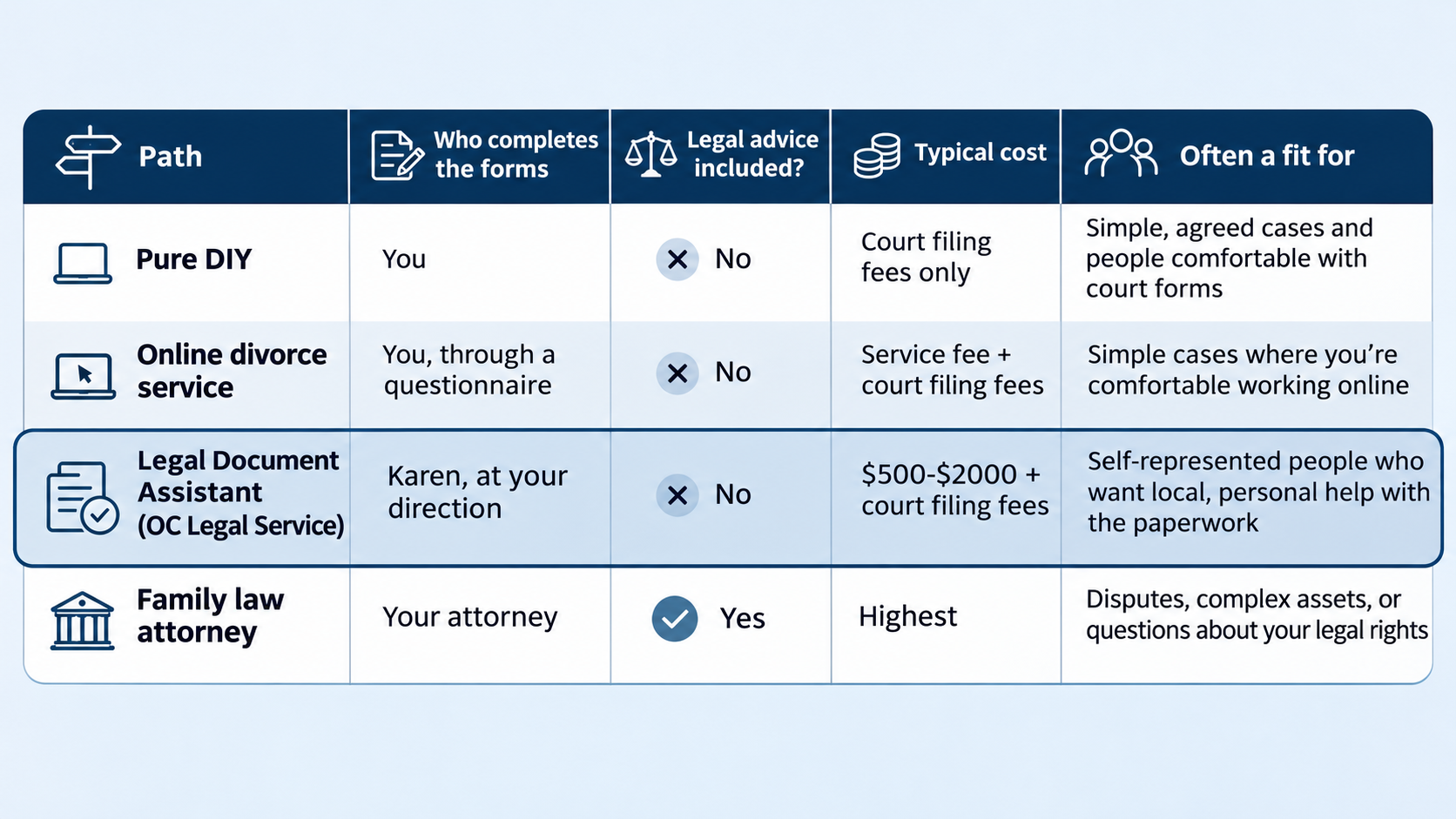
Legal Service Comparison Chart

A Legal Document Assistant cannot give legal advice. If you need advice about a specific decision, you can consult a California family law attorney separately while handling the rest yourself.

I’m Karen Fischer, a professional Legal Document Assistant at OC Legal Service, and I’ve helped individuals throughout Orange County with the administrative paperwork involved in divorce.

Some come to me before they’ve filed anything. Others have spent weeks trying to complete their own documents. And some have already received paperwork back from the court because something was missing or needed to be corrected.

My goal isn’t to take control of your divorce. It’s to help you take control of the paperwork.

Let’s talk about what a DIY divorce actually involves, what it costs in Orange County, where people commonly run into challenges, and how I can help make the document preparation process a little less overwhelming.

What Exactly Is a DIY Divorce in California?

A DIY divorce simply means that you are representing yourself rather than hiring an attorney to manage your entire divorce case. You’re responsible for the decisions, documents, court requirements, and applicable deadlines.

You may be responsible for preparing:

  • The initial Petition and Summons
  • A Response, if your spouse filed first
  • Financial disclosure forms
  • Child custody and support paperwork, when applicable
  • Marital settlement agreements
  • Final Judgment documents

You also need to understand the court’s filing and service procedures.

For some people, this process feels manageable. For others, it’s an enormous amount of responsibility to take on during an already emotional time.

And here’s something I always want people to remember: you can be perfectly capable of making your own decisions and still need help completing the paperwork. Those are two very different things. That’s where professional document preparation comes in.

Is a DIY Divorce the Right Fit for You?

When DIY Divorce May Be a Practical Option

For people with relatively straightforward circumstances, representing themselves may be an affordable way to move through the divorce process. For example, you and your spouse may:

  • Agree that it’s time to end the marriage.
  • Have already reached an agreement about dividing property and debts.
  • Have relatively simple financial circumstances.
  • Agree on parenting arrangements and support.
  • Be comfortable making your own decisions about the terms of your divorce.

You may not need an attorney to handle every administrative task involved in your case. However, if there are disagreements about property, retirement accounts, custody, support, or other significant legal matters, it’s important to consult a qualified family law attorney.

What If You Agree on Some Things, But Not Everything?

This is where it gets more complicated. Maybe you agree about the house but not retirement. Maybe you’re comfortable with the parenting schedule but uncertain about financial support. Or maybe your spouse says everything is settled, but you still have questions about what the agreement means for your future.

These are legal questions. As a Legal Document Assistant, I cannot advise you about which decisions to make, what settlement terms to accept, or what your legal rights may be. But once you’ve made those decisions yourself or received appropriate legal guidance, I can assist with preparing the documents at your direction.

You make the legal decisions. I help you prepare the paperwork that reflects them.

Learn more about my Divorce Document Preparation Services.

How Much Does a DIY Divorce Cost in Orange County?

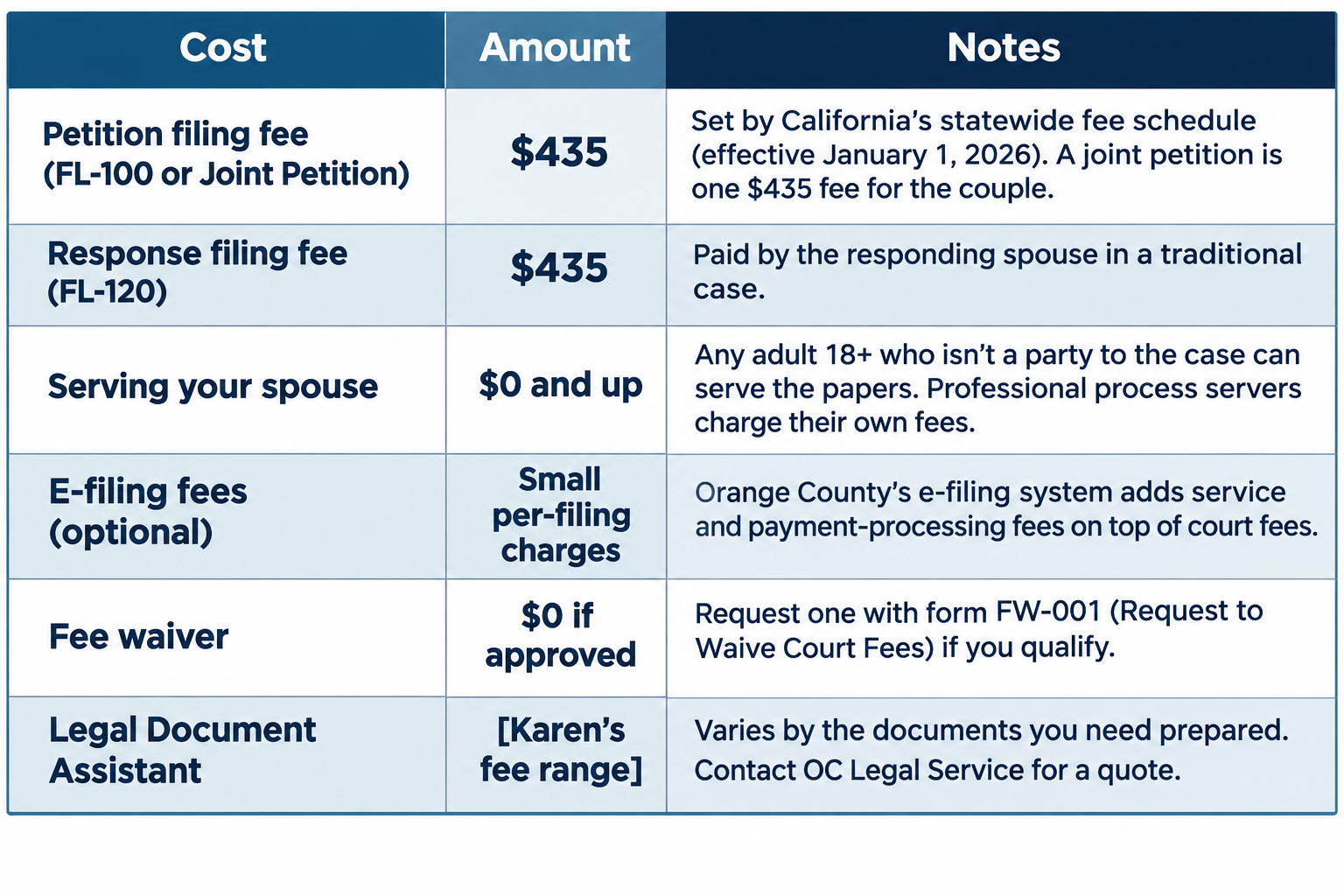
The total depends on your filing procedure, how your spouse is served, and whether you purchase any professional help. Here’s a typical breakdown:
The DIY Divorce Process: Where the Paperwork Begins

The first step in a traditional California divorce generally involves preparing and filing a Petition for Dissolution of Marriage. Common starting forms include:

  • FL-100 — Petition: The document that initiates the divorce and identifies the issues being brought before the court.
  • FL-110 — Summons: Provides important information and notifies your spouse of the proceedings.
  • FL-105 — Declaration Under UCCJEA: Generally required when you and your spouse have children under 18 together.

Additional documents may be required depending on your circumstances.

Not sure what information you’ll need before you start? Use my Divorce Preparation Checklist to gather your documents, finances, and key dates before you begin filling out forms.

Before you file, California generally requires that either you or your spouse have lived in the state for six months and in the filing county for three months.

You can review the official requirements and forms through the California Courts Divorce Self-Help Guide.

A New Option for Couples Filing Together in 2026

California introduced a new joint divorce petition process on January 1, 2026. This allows qualifying couples who expect to reach agreement on all the final terms to begin their divorce together rather than having one spouse file against the other.

The process uses a Joint Petition (FL-700) and other required documents. It does not eliminate financial disclosures, agreements, or final Judgment paperwork.

There is also a separate, simplified process called summary dissolution for couples who meet its stricter eligibility requirements.

These options are not appropriate for everyone, and deciding which procedure fits your legal circumstances may require advice from an attorney. You can learn about the Joint Petition Process directly through the California Courts.

How I Can Help With Your Initial Paperwork

Imagine you’ve downloaded the forms and sat down at the kitchen table, determined to get started. Then you see page after page of unfamiliar terminology, and something you thought would take an afternoon becomes a source of stress.

I can help prepare the forms you’ve selected using the information and instructions you provide, check for missing administrative details, and organize the paperwork for filing. I can also assist with electronic filing where permitted by the court.

You don’t need to become an expert at formatting court documents just because you’ve decided to represent yourself.

Explore How OC Legal Service Can Help.

Where to File in Orange County

Family law cases in Orange County are filed with the Superior Court of California, County of Orange, at the Lamoreaux Justice Center, 341 The City Drive South, Orange, CA 92868. The family law clerk’s office is open Monday through Friday, 8:00 a.m. to 4:00 p.m.

Free Help From the Court’s Self-Help Center

The Orange County Superior Court offers in-person family law self-help services at the Lamoreaux Justice Center and the Central Justice Center in Santa Ana, along with live self-help kiosks at several other courthouses. Self-help staff can explain procedures and review forms, but they cannot give legal advice. Check the court’s Self-Help Family Law page for current hours and appointment options.

E-Filing in Orange County

Self-represented litigants in Orange County are not required to e-file, but you can choose to. If you do, you’ll file through an approved Electronic Filing Service Provider (EFSP), and small e-filing and payment fees apply on top of court fees.

Not every family law document can be e-filed. Ex parte documents, for example, cannot currently be submitted electronically. Check the court’s Family Law eFiling exceptions list before you submit.

Serving Your Spouse

When starting a traditional divorce case, filing your documents is only one part of the process. Your spouse generally must also be formally served with the required paperwork, and a Proof of Service must be filed with the court.

What Happens When the Court Rejects Your Documents?

This is one of the biggest frustrations people experience with DIY divorce. You spend hours completing your forms, submit everything, and then receive a rejection notice.

Common reasons divorce paperwork is sent back include:

  • Missing signatures or dates on one or more forms
  • Missing required forms, such as the FL-105 when you have minor children
  • Incomplete or inconsistent information between forms, such as different dates of separation
  • Formatting problems, including incorrect case captions or unreadable scans
  • Unpaid filing fees or an incomplete fee waiver request
  • Using the wrong filing method, such as e-filing a document on the court’s exceptions list
  • Missing or incorrect Proof of Service

Each rejection means revisiting the paperwork, and that’s where DIY starts to feel a lot less simple.

How I Help Reduce Paperwork Frustration

At OC Legal Service, I assist with preparing and organizing documents for court submission. I can also help prepare documents for resubmission according to your instructions when administrative corrections are required.

While I cannot guarantee acceptance or provide legal advice about a court’s ruling, my experience with court paperwork helps me focus on completeness, organization, and accurate transcription of the information you provide.

Already started your divorce and need help with your documents? Contact Karen Fischer Today or call or text 714-209-8500.

“Wait, I Have to List All of That?”

Yes. California generally requires both spouses to exchange financial disclosures during the divorce process, and these documents can be more involved than people expect. You may need to provide information about:

  • Income and employment
  • Bank and investment accounts
  • Retirement accounts and pensions
  • Real estate
  • Vehicles
  • Credit cards and outstanding debts
  • Monthly household expenses
  • Other assets and financial obligations

Common documents include:

  • FL-140 — Declaration of Disclosure
  • FL-150 — Income and Expense Declaration
  • FL-142 or FL-160 — Schedule of Assets and Debts or Property Declaration
  • FL-141 — Declaration Regarding Service of Declaration of Disclosure

Preliminary financial disclosures are generally required within 60 days of filing a Petition or Response. The disclosure documents are exchanged with the other party, while FL-141 is filed with the court to confirm that the required exchange took place.

The Real Challenge? Getting Everything Organized.

This can feel overwhelming, especially for someone who hasn’t traditionally handled the household finances. Start by gathering the records you can locate, and don’t guess at financial information. If you have questions about how property should be legally classified or divided, consult an attorney or another qualified professional.

For more help getting organized, read my Divorce Preparation Checklist.

How I Help With Financial Disclosure Preparation

I can assist with organizing your financial information and preparing the disclosure forms you’ve selected using the details you provide. I’ll also help identify missing information needed to complete those documents administratively.

You remain responsible for the accuracy and completeness of your disclosures and for making your own financial and legal decisions. But you don’t have to manage every administrative detail without assistance.

You’ve Reached an Agreement. Now What?

Let’s say you’ve worked through the difficult conversations, decided how to divide your property, and reached an understanding about parenting arrangements. You may feel like the hardest part is behind you. But legally, an agreement alone doesn’t finalize your divorce.

California requires the appropriate final documents to be prepared, submitted, and approved by the court. Depending on the type of case, this may involve:

  • A written marital settlement agreement
  • A Judgment (FL-180)
  • A Notice of Entry of Judgment (FL-190)
  • Additional supporting forms, attachments, or required declarations

A final Judgment packet can involve multiple documents that must correspond with the terms you’ve already established.

How I Can Help You Reach the Paperwork Finish Line

At OC Legal Service, I assist with preparing stipulated marital settlement agreements and final Judgment packets at your direction. That means I can help put your chosen or attorney-reviewed terms into the appropriate documents and organize the paperwork for submission.

I cannot determine whether your agreement is fair, advise you to waive rights, or evaluate its legal consequences. For those questions, a licensed attorney is the appropriate resource.

Learn More About Divorce Judgment Preparation.

The Hidden Costs of DIY Divorce

Saving on Attorney Fees Doesn’t Mean Mistakes Are Free

One of the biggest motivations behind a DIY divorce is saving money, and I understand that. But there’s another cost people sometimes overlook: your time. Researching court forms, organizing financial paperwork, figuring out formatting requirements, and correcting rejected submissions can take hours, often on evenings and weekends when you’d rather focus on your future.

An Affordable Middle Ground

You can represent yourself and hire a professional Legal Document Assistant to help prepare and submit documents at your direction. You keep control of your case while paying for help with the paperwork. If you need legal advice about a particular decision, you can separately consult a California family law attorney.

Five Ways to Make Your DIY Divorce More Manageable

  1. Create One Divorce Folder. Keep your court documents, financial records, important correspondence, and filing confirmations in one secure location, digital or physical.
  2. Separate Your Questions Into Two Categories.
  • Paperwork Questions: Information you need to gather, documents you’ve selected for preparation, filing logistics, and administrative tasks.
  • Legal Questions: Property rights, support obligations, custody disputes, agreement terms, and decisions about your legal options.

This helps you understand which questions are appropriate for a document preparer and which require advice from an attorney.

  1. Don’t Assume One Filing Means You’re Finished. The initial Petition is the beginning, not the entire divorce. Financial disclosures, service requirements, agreements, and final Judgment documents may still be necessary.
  2. Keep a Record of Important Dates. Document when papers are filed, when service takes place, and when other requirements are completed. California has a mandatory waiting period before a divorce can become final. For traditional divorce cases, the minimum six-month period generally runs from service of the initial papers or the responding spouse’s first appearance, whichever occurs first. For the new joint petition process, it generally begins when the joint petition is filed. Your divorce does not automatically become final when the waiting period ends; court approval and the appropriate Judgment are still required.
  3. Ask for Professional Help Before You’re Completely Overwhelmed. Maybe you only need help preparing your initial Petition, responding to divorce papers, or completing your final Judgment packet. Getting help with paperwork doesn’t mean you’ve failed at doing it yourself. It means you’re being resourceful.

Frequently Asked Questions

Yes. California allows individuals to represent themselves in divorce proceedings. You remain responsible for your legal decisions, court requirements, and deadlines. A registered Legal Document Assistant can provide permissible document preparation and filing services at your direction.

Family law cases are filed with the Orange County Superior Court at the Lamoreaux Justice Center, 341 The City Drive South, Orange, CA 92868. Self-represented filers can also choose to e-file through an approved provider.

No. Individuals may represent themselves in contested or uncontested cases. However, disagreements and complicated legal issues can make self-representation more challenging. If your divorce involves disputes or uncertainty about important legal rights, consulting a licensed attorney is strongly recommended.

Yes. You can contact OC Legal Service about assistance with your remaining paperwork. Karen can help prepare or correct administrative aspects of documents at your direction. Legal review of the substance of your forms must be performed by a qualified attorney.

Yes. If you’ve been served with divorce papers, you may need to prepare a Response (FL-120). In a traditional divorce, the responding spouse generally has 30 days after being served to file a Response. Karen can assist with preparing and filing the Response you direct her to complete. If you are uncertain about how you should legally respond, speak with an attorney promptly.

The court filing fee for a Petition for Dissolution of Marriage is $435 under California’s 2026 statewide fee schedule, and a responding spouse pays $435 to file a Response. A joint petition is a single $435 fee. Service and optional e-filing fees may add to the total, and qualifying individuals can request a fee waiver using form FW-001. Karen can provide information about her document preparation fees and assist with preparing fee-waiver paperwork at your direction.

Yes. OC Legal Service offers preparation of final Judgment packets and stipulated marital settlement agreements at the client’s direction. The court must review and approve the required documents. Karen cannot guarantee an outcome or a specific date when your divorce will become final.

Your Divorce. Your Decisions. Professional Help With the Paperwork.

Divorce can make even the most organized person feel overwhelmed. You’re making decisions about your home, your finances, your family, and your future, and somewhere in the middle of all that, you’re expected to understand a complicated collection of legal forms.

I believe that people who choose to represent themselves deserve access to affordable, professional document preparation services. DIY doesn’t have to mean doing everything alone.

My goal at OC Legal Service is to help you stay organized, reduce paperwork frustration, and move through your document preparation tasks with greater confidence. You focus on the future you’re building. I’ll help with the paperwork.

Ready to Make Your DIY Divorce in Orange County a Little Easier?

Whether you’re just beginning the divorce process, responding to paperwork, or preparing to finalize your Judgment, I’m here to help with professional document preparation.

Karen Fischer | OC Legal Service Professional Legal Document Preparation in Orange County, California Call or Text: 714-209-8500

Explore Divorce Document Preparation Services | Contact Karen Fischer Today

Your decisions. Your future. Professional help with the paperwork.

Important Notice: Karen Fischer is not an attorney. OC Legal Service provides legal document preparation and filing assistance at the specific direction of self-represented clients. Karen cannot give legal advice, select legal forms or strategies for you, evaluate legal rights, or represent you in court. If you need advice about divorce, custody, property, financial obligations, or settlement terms, consult a licensed California attorney. This article provides general information and is not legal advice.


About the author : Juliet Ekinaka